Simon Holden is a Queenstown-based interactive installation artist whose practice sits at the intersection of sensors, sculpture, and code. By day he's an integrator working on high-end smart-home automation; the same skills underpin the large-scale interactive instruments and environments he builds outside of work. He's bringing ARC to Te Ramaroa 2026, a hand-tracked instrument that turns whoever stands inside it into both performer and audience.
Tell us a bit about how you got into this world:
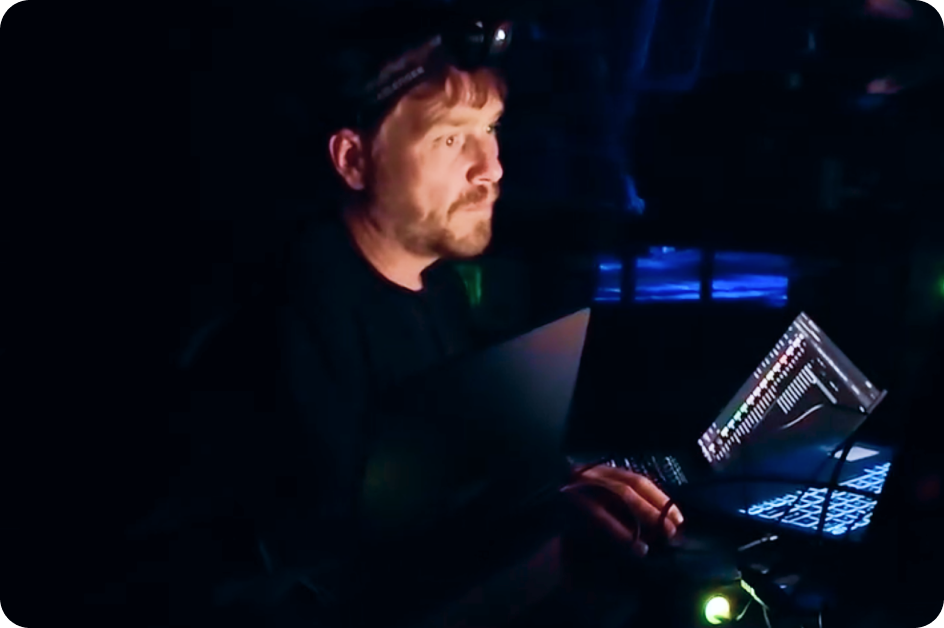
I've always been a tinkerer. Someone who takes stuff apart and tries to put it back together, but also tries to put it back together in a different way than it came apart. Dad got me into a lot of the technical stuff. He was a very early adopter in the 70s. I remember him buying a computer much to the dismay of my mum, this 16-colour Amstrad that you'd look at now and think how ancient is that, but at the time it was pretty forward thinking.
I never really learned traditional programming, though. As soon as visual, node-based programming came along, that was where I loved to sit. And now with AI, all those years of not learning to program has actually been to my benefit. I can set a few parameters and let it do the technical heavy lifting, and concentrate much more on the artistic side.
What does that artistic side look like for you?
I was hugely into comic book art and really detailed drawings. Futuristic buses, fire trucks, things with beautiful shape and form but function at the same time. I think my art still expresses a lot of that. Form, function, and this underlying technical side that you don't actually see on the surface, where a huge amount of thought has gone in. You think about a fire truck and the compartments, why they sit where they do, the ergonomics. There's a massive practical side as well as a beautiful machine. That tension is what I'm chasing.
I also love simple things. I love just a button, and it does a huge amount. There's a curiosity shop in Curio Bay where this guy has all these crazy machines. Things that do nothing. You turn a lever and it just goes that way. But he's got this "Do Not Push This Button" sign, and if you push it, it squirts water from about five metres away straight at your face. Other people can see it coming, you can't. It's just so beautiful. One single thing, one single reaction.
The best magic tricks are the simplest ones. It's not even sleight of hand. It's just so basic that your mind can't pick up on it because you're looking for something complex. That's the magic. I just want people to play. To go back to being an infant, in that state of awe where you don't need to figure it out.

Talk us through ARC, what you're bringing to the festival:
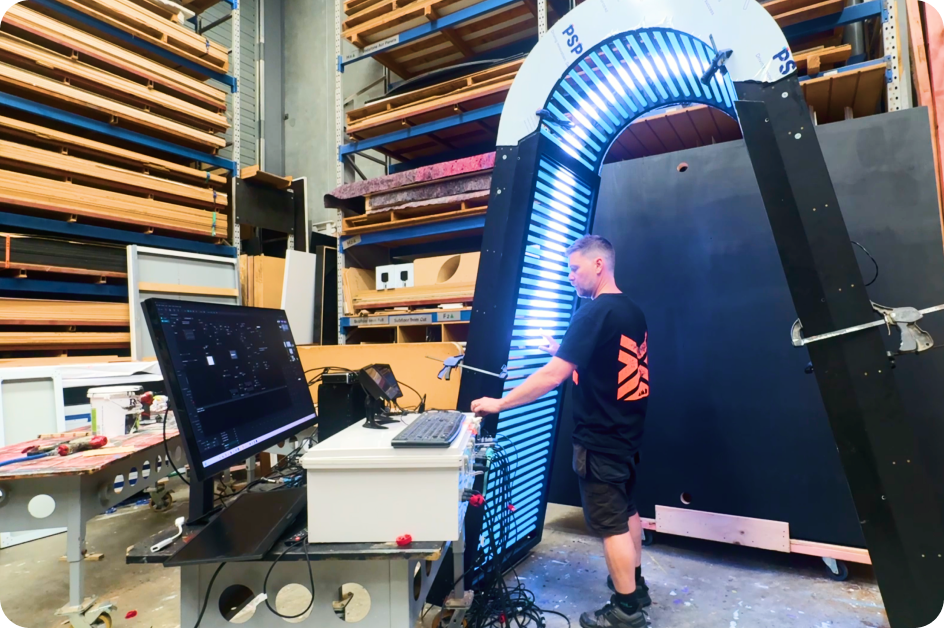
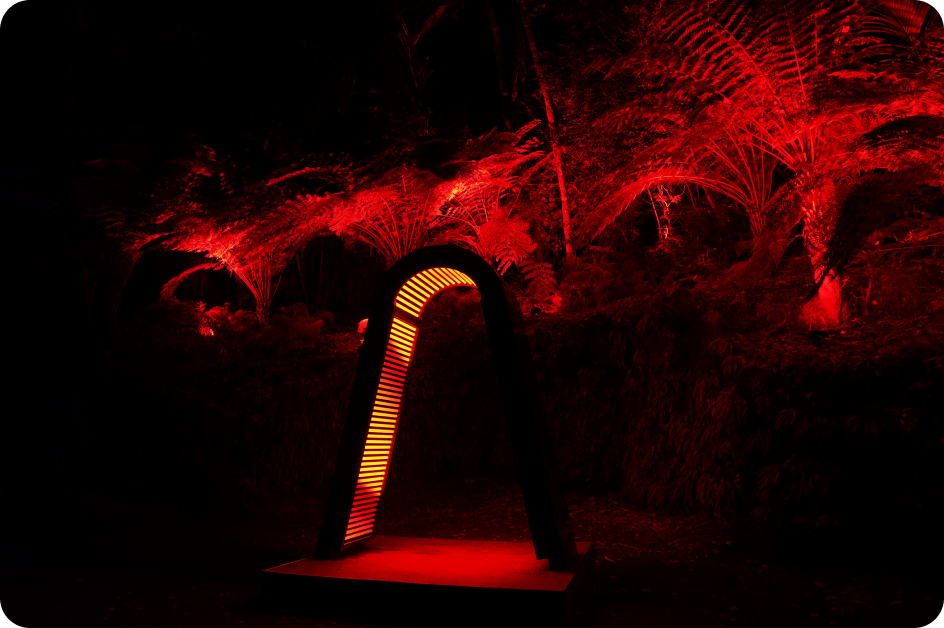
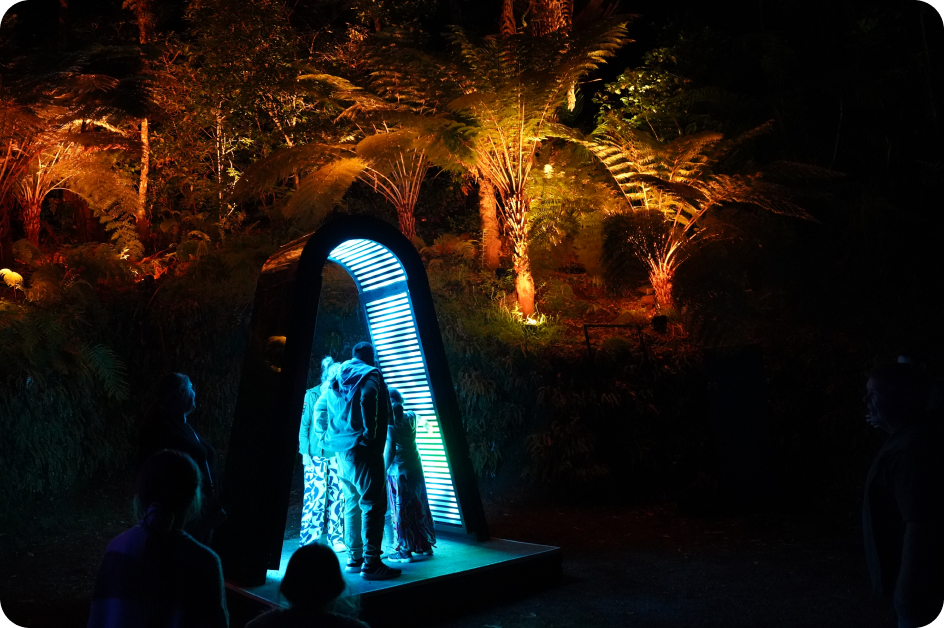
ARC is a big interactive instrument. From top to bottom on either side there are eight zones, each delivering a key to a synth, with a different synth for each side. When you move your hand right to left within a key, you alter the cutoff for a filter operating on that synth. I change the synths to suit the location. For the recent install at The Core I deliberately put the keys slightly out of perfect mesh, mixing minors and majors, so you get that "this doesn't quite fit but it does" feeling.
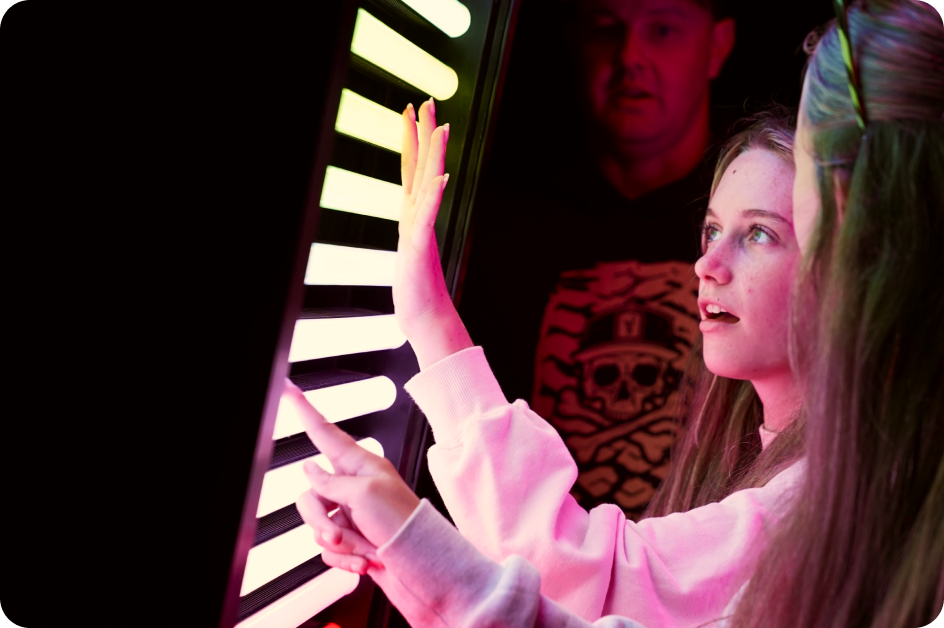
The sensing is just IR frames sitting in front of LED bars. When you break the field, it knows where you are. From that XY data I drive particles and filters. Touch one side, particles fire across to the other, twist around each other, meld, create new colours. It's all fluid dynamics.
The clever bit is when ARC sits in a real environment. If it's in front of trees with lights strung through them, I map those lights into the same geometry. So when you play on one side and light flows up through ARC, it also flows out along the avenue of trees. From inside the piece you don't see that at all, but the people watching see this huge sculptural performance you're unwittingly conducting. Micro-macro. Subtle, but it has a big impact.
There's a real emphasis in your work on the sculptural side, not just the digital. Is that deliberate?
I like people to not feel like the piece is an AI piece. You can touch it. It feels unreal but it took time. There's no undo button when you're dealing with materials. You make a mistake, you re-cut. Wood is forgiving until it's not. You cut a piece of 9mm ply with a jigsaw, it doesn't look right, you cut another one.
A lot of modern interactive work is just a bunch of projectors and a bunch of walls, tracking people and reacting. It's a touch-designer patch gone crazy. Fascinating and lovely, but nothing's actually been created. Someone made the projectors, someone made the surface, but that's it. Where I want to play is in the blend, sculptural and digital working together. Materials I've actually shaped, meshing with input data and reflections in the real world.
Why are regional festivals like Te Ramaroa important to you?
I live in a regional place, so I get it. It's pushing it uphill sometimes trying to get people to realise there's actually really good stuff locally. The attention economy has made it really difficult to push local art because everybody's just looking at their Instagram feeds of incredible artists doing incredible things globally. It's like blinders. Like nothing's happening locally. But there is, actually. Artists pushing the boundaries in your neighbourhood.
Having festivals like yours that celebrate that is really important. It can be eye-opening for people to go: this is coming from New Zealand, this is from a regional area, this isn't from a hugely funded university arts department with 150 people working on something. This is one person pushing their own thing.
What would you say to someone just getting into this kind of work?
It's a tough one. I've always been a self-learner, so I just jump online. Arduino is a really great place to start. I've got probably a hundred of them. Microcontrollers in general are a really fun place to start experimenting. And programs like Touch Designer short-circuit a lot of the heavy programming. You can cut and paste, mesh things together, make your own thing out of them.
But honestly, the journey is just play. I love getting into the workshop tidying it up, then messing it all up again. Getting into a state of complete disarray because you've gone in so many tangents. And then you come out with a really cool idea, tidy the place again, and make the thing.
Don't be afraid to get rid of work either. I do this a lot. You get to a certain point and you go: this is actually a shit idea. Move on. It was good at the time, it served its purpose. Quite often I'll go back to scrapped projects years later and use them as the basis of a new one. The LED elements in ARC came from another piece called Trilogy that I scrapped and stripped down. There's something cathartic about that. Every artwork exists in a specific moment, in its environment, with the specific people interacting with it. They're not static. They get to have their moment, then the materials get to do something new.
Watch the full interview:
Simon Holden is exhibiting ARC at Te Ramaroa 2026, 3 to 7 July, Nelson. The festival is free to attend.


